Majesco's TV Arcade: The 2004 Plug-and-Play Game Line
Majesco's TV Arcade was a line of self-contained plug-and-play video game products introduced during Majesco's expansion beyond conventional console and handheld software in 2004. Instead of requiring an Xbox, PlayStation 2, GameCube or other dedicated console, a TV Arcade unit combined the controller and game hardware into a single device that connected directly to a television.
The concept was deliberately simple: insert batteries, connect the unit to a television through standard audio/video cables and play the software already stored inside the device. Majesco later described TV Arcade in its corporate filings as a stand-alone, firmware-enabled game system requiring no additional game hardware or software.
TV Arcade was therefore not one individual video game. It was a Majesco product line built around inexpensive dedicated game devices, with documented releases including Frogger TV Arcade, a Konami arcade compilation and Golden Nugget Casino. The line represents a lesser-known but revealing part of Majesco's 2004 strategy: expanding its business into low-cost gaming hardware while simultaneously publishing conventional games for major platforms.
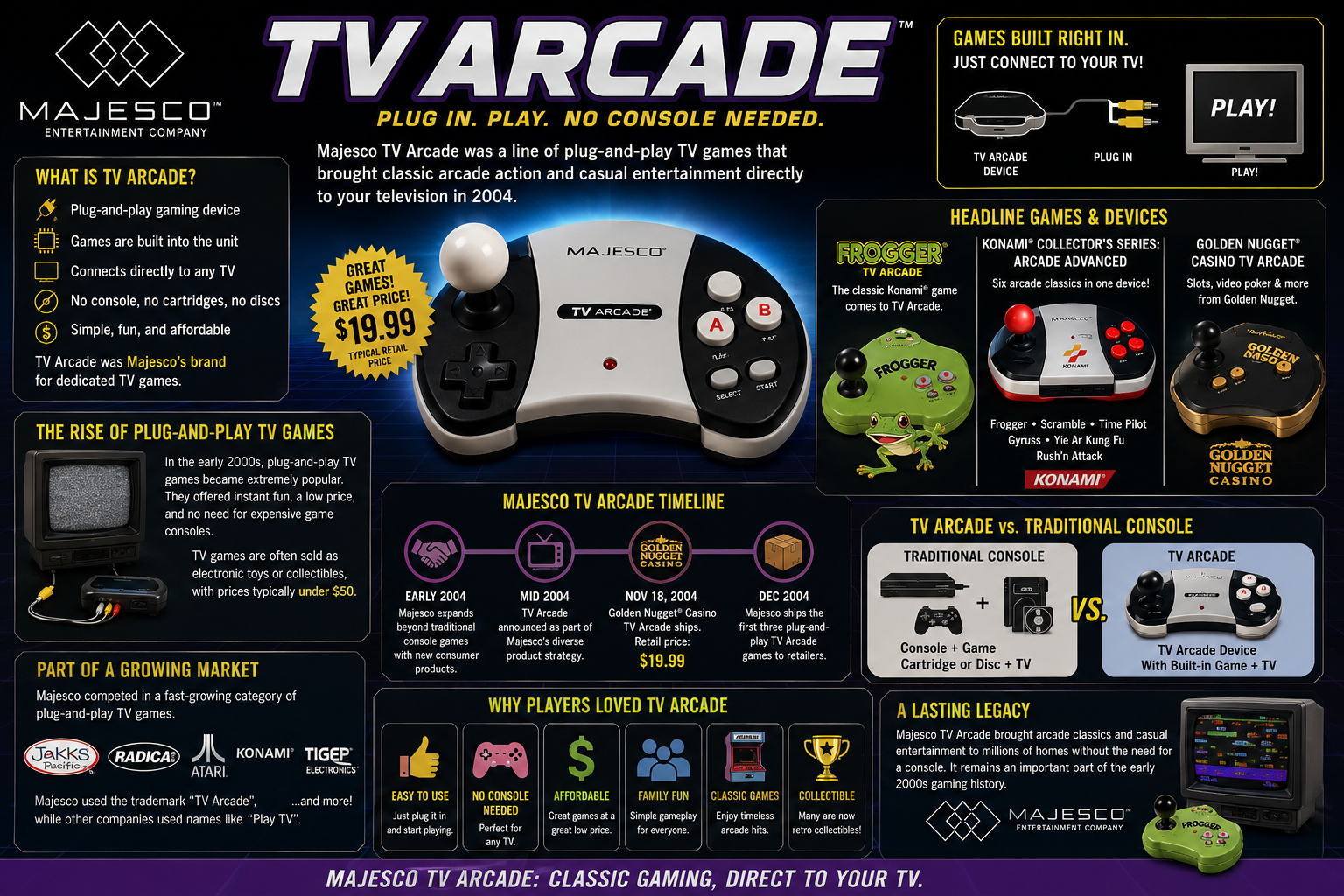
Modern archive illustration representing Majesco's TV Arcade plug-and-play game line from the 2004 period. This is a contemporary archival reconstruction, not original Majesco packaging or promotional artwork.
Majesco's TV Arcade at a Glance
| Product Line | Majesco's TV Arcade |
|---|---|
| Company | Majesco Sales Inc. / historical Majesco organization |
| Introduced | 2004 |
| Product Type | Plug-and-play TV game system |
| Connection | Standard RCA audio/video connection to a television |
| Power | Battery operated |
| Software | Games pre-installed in the unit |
| Dedicated Console Required | No |
| Documented 2004 Products | Frogger TV Arcade, Konami Collector's Series / Arcade Advanced TV Arcade, Golden Nugget Casino TV Arcade |
| Historical Role | Majesco peripheral and dedicated-game product line |
What Was a TV Game?
Plug-and-play television games occupied a distinctive part of the early-2000s game market. Instead of functioning like a conventional console with interchangeable cartridges or discs, the software was built directly into the controller or dedicated game unit.
A historical overview preserved by Academic Kids describes TV games as self-contained systems powered by batteries or an AC adapter and connected directly to a television or VCR. The software was normally built into the device itself, which meant users did not need a separate game console.
The same reference identifies the rise of the category after products such as Jakks Pacific's Atari Classic 10-in-1 and records the proprietary names used by competing manufacturers. Radica called its line Play TV; Majesco used TV Arcade.
Most of these products occupied a price and retail category closer to electronic toys or collectibles than full-size consoles. That made the format particularly suitable for familiar arcade properties: a consumer could buy a recognizable game or collection and play it immediately without owning another system.
Why Majesco Entered the Plug-and-Play Market
TV Arcade appeared during a period when Majesco was deliberately broadening its business beyond conventional packaged software.
In June 2004, Majesco's financial results described a company benefiting heavily from Game Boy Advance products but preparing a wider second-half lineup. Chief executive Jesse Sutton specifically named TV Arcade alongside Wireless Messenger as new products intended to support the company's future growth. GameSpot's contemporary report on Majesco's second-quarter results preserves that announcement.
The strategy becomes even clearer in Majesco's later filings with the U.S. Securities and Exchange Commission. The company classified TV Arcade among its peripheral products and described the units as stand-alone games that connected directly to television sets through standard RCA cables, operated on batteries and required no additional hardware or software. Majesco Entertainment Company's SEC filing provides the strongest corporate description of the product category.
TV Arcade therefore belongs naturally beside Majesco's other experiments in gaming hardware and accessories. The broader Majesco Hardware and Accessories archive documents this side of the company's history, while the Game Boy Advance Accessories record covers another group of hardware-oriented products from the same general expansion period.
The Konami Agreement
Classic Konami properties were central to Majesco's initial TV Arcade strategy.
In May 2004, Majesco announced a licensing agreement with Konami covering multiple plug-and-play game systems. Contemporary reporting described plans for five systems, with the first products based on Frogger and Konami Arcade Classics.
Slashdot's contemporary report, which referenced the original announcement, preserved Majesco's plan to bring the first two Konami-based TV game systems to retail during the fall of 2004.
The agreement fit the format particularly well. Plug-and-play hardware benefited from games that were immediately recognizable and did not require complex modern controllers or lengthy setup. Classic arcade properties such as Frogger could be placed directly into a joystick-shaped device and sold as a self-contained experience.
Majesco's later SEC filings also preserve a broader contractual relationship between Majesco Sales Inc. and Konami of America, including software distribution agreements predating the TV Arcade launch.
Frogger TV Arcade
Frogger became the most clearly documented individual product associated with Majesco's TV Arcade line.
The dedicated unit packaged Frogger into a self-contained controller that could be connected directly to a television. MobyGames records Frogger TV Arcade as a 2004 dedicated-console release published by Majesco Sales Inc. View the MobyGames release record.
The importance of Frogger was primarily commercial and structural rather than technological. It gave Majesco's new hardware line a recognizable arcade name at a time when retro-oriented plug-and-play products were becoming increasingly visible at retail.
A later historical overview of Majesco similarly described Frogger as the title that headlined the company's first TV Arcade products.
Konami Collector's Series: Arcade Advanced
Majesco also used the TV Arcade concept to package multiple Konami games into one unit.
The commonly documented Konami Collector's Series: Arcade Advanced TV Arcade product included six Konami titles:
- Frogger
- Scramble
- Time Pilot
- Gyruss
- Yie Ar Kung-Fu
- Rush'n Attack
Unlike the standalone Frogger unit, the compilation demonstrated another advantage of dedicated plug-and-play hardware: a single controller could act as a compact collection of older games without requiring cartridges, discs or a general-purpose console.
Surviving enthusiast documentation indicates that not every game in the unit was a literal arcade-hardware emulation. Some software appears to have originated from or resembled earlier console conversions, while other ports were developed specifically for the dedicated hardware. Because detailed engineering records remain incomplete, this archive does not treat the unit as a perfect reproduction of the original arcade machines.
That distinction is worth preserving. The historical importance of TV Arcade lies in how Majesco packaged and marketed classic games, not in claiming that every built-in version reproduced its original arcade hardware exactly.
Golden Nugget Casino TV Arcade
The TV Arcade line was not limited to classic Konami properties.
By November 2004, Majesco had also released a Golden Nugget Casino TV Arcade product under a licensing agreement with the Las Vegas Golden Nugget casino.
GameSpot reported on November 18, 2004 that the self-contained TV Arcade version had already shipped to retail. The unit offered several forms of video poker and slot-style games and carried a suggested retail price of $19.99. A separate Golden Nugget Casino release was also available for Game Boy Advance at the same price. Read GameSpot's contemporary Golden Nugget report.
The product illustrates that Majesco viewed TV Arcade as a format rather than a single retro-game franchise. The same basic hardware concept could support an arcade property such as Frogger, a multi-game Konami collection or a licensed casino-themed product.
A Game System Without a Console
The defining feature of TV Arcade was its removal of the traditional console from the transaction.
Majesco's own later corporate description is unusually explicit: TV Arcade products were battery-operated stand-alone games, connected to televisions with standard RCA cables, with no additional hardware or software required.
The company's financial filing also described the system more technically as a firmware-enabled joystick containing pre-installed video games.
This placed TV Arcade in a category very different from Majesco's Xbox, PlayStation 2, GameCube or Game Boy Advance releases. A game such as BloodRayne 2 required an existing console and was sold primarily as software. A TV Arcade product was both the game device and the software package.
That difference is why it is more accurate to preserve TV Arcade as a historical product line rather than treating “TV Arcade” as the title of one Majesco video game.
The Majesco's TV Arcade Trademark
Majesco also formalized the product identity as a trademark.
The MAJESCO'S TV ARCADE trademark application was filed on June 18, 2004 by Majesco Sales Inc. for portable video game machines intended for use with televisions. The registration record lists October 31, 2004 as the first-use date in commerce.
The mark eventually received U.S. registration number 3136698 on August 29, 2006. It was later cancelled in 2013 after the required Section 8 maintenance period. The trademark record is preserved by Justia.
The filing is valuable archival evidence because it independently confirms that “Majesco's TV Arcade” was not merely an informal description used by retailers. It was a specific branded product identity pursued by Majesco Sales Inc. during 2004.
Independent Evidence of the TV Arcade Brand
Historical third-party references also preserve Majesco's position in the TV-game market.
The Academic Kids TV game reference identifies Majesco among manufacturers of self-contained TV games and specifically records TV Arcade as Majesco's branded name for this category.
More significantly for reconstructing the domain's historical role, that reference also treated Majesco's own TV Arcade section as an external reference for the product category at the time.
The original historical Majesco destination is intentionally not reproduced here. The current archive uses only active MajescoGames.com canonical URLs, while the old reference remains useful as independent evidence that the domain itself once hosted material for the TV Arcade product line.
This is exactly the type of evidence the historical archive is designed to preserve: not merely that Majesco sold a product, but that independent sources connected that product identity directly with Majesco and with the company's web presence.
TV Arcade and Majesco's 2004 Diversification
TV Arcade becomes more meaningful when placed inside the broader Majesco business of 2004.
During the same year, Majesco was operating across several very different segments of interactive entertainment. It was publishing conventional console games, expanding Game Boy Advance Video, experimenting with wireless GBA accessories and preparing dedicated plug-and-play hardware.
That means TV Arcade was not an isolated curiosity. It was part of a deliberate effort to diversify the company beyond the traditional model of selling one game disc or cartridge for an existing platform.
Contemporary reporting on Majesco's financial results specifically grouped products such as TV Arcade and Wireless Messenger with the company's plans for future growth. Later corporate filings similarly treated TV Arcade as a defined category within Majesco's peripheral business.
This broader context is important because the line appeared during the same period that Majesco was also investing heavily in more conventional releases. The company could market a major console title on one side of its catalog while simultaneously selling an inexpensive self-contained joystick on the other.
Why TV Arcade Belongs in the Majesco Games Archive
TV Arcade is historically useful because it documents a side of Majesco that is easy to miss when looking only at its better-known boxed video games.
The product line shows Majesco acting simultaneously as:
- a video game publisher;
- a licensee of established entertainment properties;
- a marketer of dedicated gaming hardware;
- a participant in the early-2000s plug-and-play TV game market;
- and a company experimenting with gaming products outside conventional consoles.
Frogger demonstrates the use of an established arcade property. The Konami compilation demonstrates the value of bundling multiple recognizable games into dedicated hardware. Golden Nugget demonstrates that the same format could extend beyond classic arcade games into another licensed entertainment category.
Together, those products make TV Arcade more than a footnote. They provide a compact example of Majesco's licensing, value-product and hardware strategies converging in one product family.
Historical Perspective
Plug-and-play television games were an important transitional category in early-2000s consumer gaming.
They were simpler and cheaper than full consoles, but more substantial than a traditional handheld electronic toy. By combining the controller, hardware and software into one device, companies could sell familiar games to consumers who did not need to understand platform compatibility or buy additional software.
Majesco entered that market at a moment when several manufacturers were competing with their own branded versions of the same basic idea. Academic Kids' surviving overview places Majesco's TV Arcade alongside products from Jakks Pacific, Radica and other manufacturers, showing that the category had become recognizable enough to develop its own naming conventions and retail identity.
TV Arcade did not become the defining business of Majesco. Its historical value lies elsewhere: it captures the company experimenting with another form of game distribution during one of its most active periods of diversification.
Preservation Notes
This page reconstructs Majesco's TV Arcade as a product line, not as one individual video game.
The hardware description is grounded primarily in Majesco's SEC filings, which identify TV Arcade as a battery-operated stand-alone system connecting directly to televisions through RCA cables and containing pre-installed software.
Frogger, the Konami compilation and Golden Nugget Casino are presented as documented examples from the late-2004 line. Detailed low-level hardware and software-development claims are avoided where surviving sources disagree or rely primarily on later enthusiast reverse engineering.
The Academic Kids reference is used as independent evidence of the broader TV-game category and of Majesco's branded TV Arcade identity. The historical Majesco URL recorded by that source is intentionally not reproduced in this article.
The image used here is a modern archive illustration created for the current MajescoGames.com archive. It is not original Majesco packaging, a historical product photograph or promotional artwork from 2004.
Historical Sources
- U.S. Securities and Exchange Commission — Majesco Entertainment Company Form 10-K describing TV Arcade peripheral products and the plug-and-play system
- GameSpot — Majesco's June 2004 financial results and announcement of TV Arcade as an upcoming product
- Slashdot — contemporary report on Majesco's Konami TV-game licensing agreement
- GameSpot — Golden Nugget Casino TV Arcade retail and licensing report, November 2004
- MobyGames — Frogger TV Arcade release and publisher record
- Academic Kids — historical overview of TV games identifying Majesco's TV Arcade brand
- Justia Trademarks — MAJESCO'S TV ARCADE trademark record, serial 78437545
MajescoGames.com Today
MajescoGames.com today is independently operated and should not be confused with Majesco Sales Inc. or the historical Majesco corporate entities responsible for TV Arcade.
This reconstruction forms part of the Majesco Games Archive, which preserves selected games, products, hardware and announcements associated with the earlier history of Majesco and the MajescoGames.com domain.
For the wider historical hardware collection, visit Majesco Hardware and Accessories. For an explanation of the distinction between the historical Majesco era and the website operating here today, see About MajescoGames.


